Mahalaxmi Calendar 2027 January
Sarvanche Swagat Aahe! ! The Mahalaxmi Calendar 2027 January (महालक्ष्मी कॅलेंडर 2027 जानेवारी ) calendar can be viewed here.
Mahalaxmi Calendar 2027 January: January 2027 Marathi Calendar, with every San (सण), Vrat (व्रत) and holiday of the month set out in one place. We are sharing the image of this month’s Marathi calendar right here. You can view them on this page and also print them to keep at home.
The जानेवारी मराठी कॅलेंडर 2027 opens in the closing days of Margashirsha and then moves into Paush. It covers both Ekadashi (एकादशी) vrats, Sankashti Chaturthi (संकष्टी चतुर्थी), Pradosh, Amavasya (अमावस्या) and Purnima (पौर्णिमा), along with Bhogi (भोगी), Makar Sankranti (मकर संक्रांती), Shakambhari Purnima and Republic Day. The date of each one is in the table below.
Mahalaxmi Calendar 2027 January
Here is the January 2027 Marathi Calendar for easy reference. It includes important Marathi festivals, holidays, Vrat and Upvas, Ekadashi, Tithi, Nakshatra, Panchang, Muhurat, Sankranti, and other significant dates observed during Shaka 1948–1949.
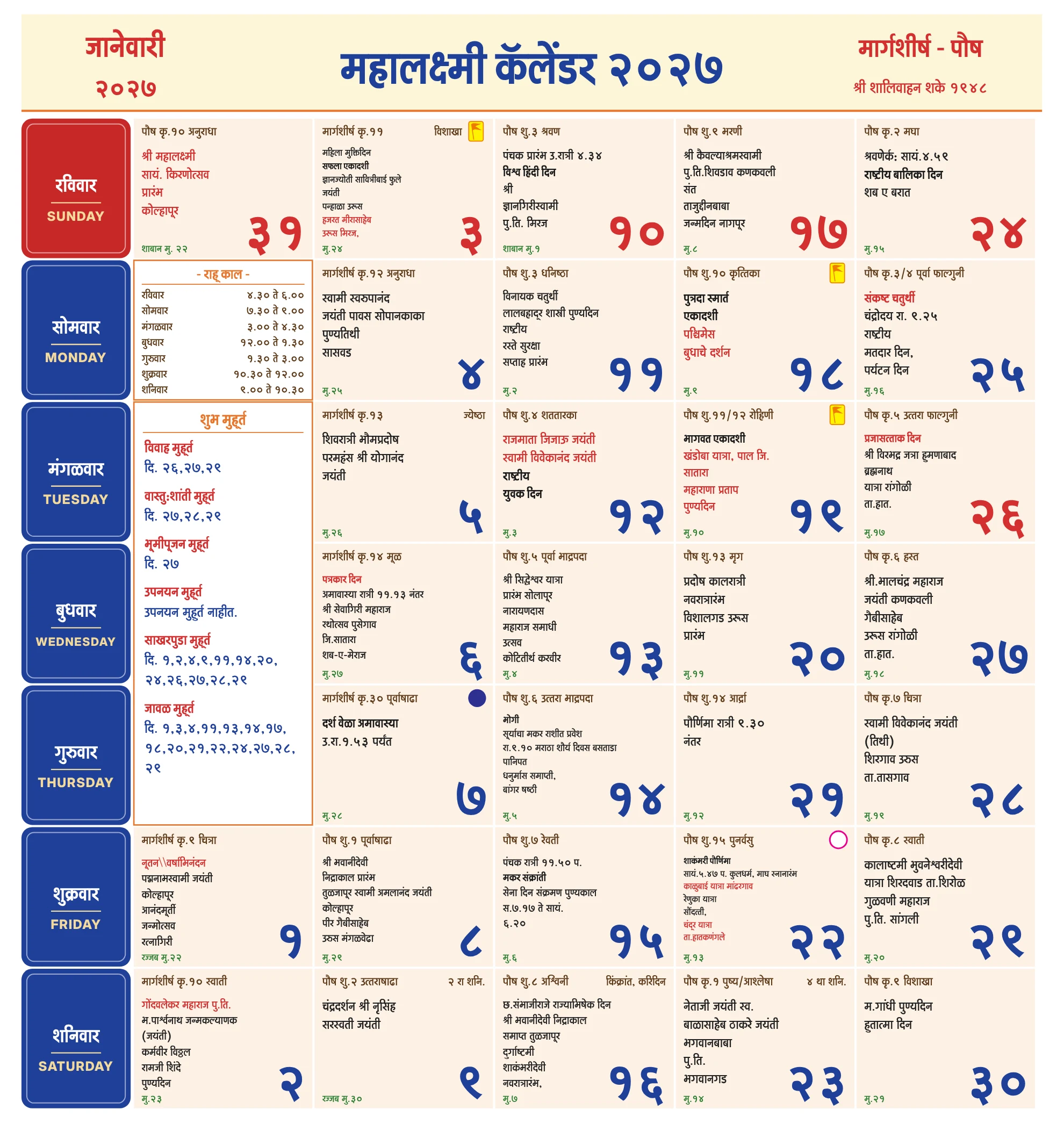
January 2027 Marathi Mahalaxmi Festivals,Vrats And Important Date
The table below lists selected festivals and observances from our Marathi calendar artwork for January 2027. Dates follow the supplied calendar JSON; times and observances may depend on location and tradition.
| Date | Day | Holiday / Festival Name | Type |
|---|---|---|---|
| 1 January | Friday | New Year’s Day | Observance |
| 3 January | Sunday | Saphala Ekadashi, Savitribai Phule Jayanti | Ekadashi, Jayanti |
| 5 January | Tuesday | Bhaum Pradosh | Pradosh |
| 5 January | Tuesday | Masik Shivratri | Masik Shivratri |
| 7 January | Thursday | Margashirsha Amavasya, last Margashirsha Guruvar | Amavasya, Vrat |
| 8 January | Friday | Paush month begins | Observance |
| 11 January | Monday | Vinayak Chaturthi | Vinayak Chaturthi |
| 12 January | Tuesday | Rajmata Jijau Jayanti, Swami Vivekananda Jayanti | Jayanti |
| 14 January | Thursday | Bhogi | Festival |
| 15 January | Friday | Makar Sankranti | Sankranti |
| 16 January | Saturday | Kinkrant | Observance |
| 16 January | Saturday | Shakambhari Navratri begins | Observance |
| 18 January | Monday | Pausha Putrada Ekadashi (Smarta) / next day (Bhagwat) | Ekadashi |
| 19 January | Tuesday | Putrada Ekadashi (Bhagwat) | Ekadashi |
| 20 January | Wednesday | Pradosh | Pradosh |
| 22 January | Friday | Paush Purnima, Shakambhari Purnima | Purnima |
| 23 January | Saturday | Netaji Subhas Chandra Bose Jayanti | Jayanti |
| 25 January | Monday | Sankashti Chaturthi | Sankashti Chaturthi |
| 26 January | Tuesday | Republic Day | Observance |
| 30 January | Saturday | Mahatma Gandhi Punyatithi | Observance |
These dates follow the Tithi present at sunrise, known as Udaya Tithi. A festival can therefore shift by a day depending on the place and the sampradaya followed.
Major January 2027 Marathi Festivals Explained
Saphala Ekadashi – 3 January
The first Ekadashi of the month falls on a Sunday. In the Amanta system followed in Maharashtra it is the Krishna Paksha Ekadashi of Margashirsha. North Indian calendars place the same day in Paush, which is why the month name may look different elsewhere.
Devotees of Vitthal and Vishnu traditionally keep a fast, offer tulsi and spend the evening in bhajan or Haripath. Many homes keep the cooking very simple that day. The fast is opened the next morning, on Dwadashi.
Margashirsha Amavasya – 7 January
This Amavasya closes the month of Margashirsha, and Paush begins the following morning. It also happens to be a Thursday, so it is the last Margashirsha Guruvar of the season.
In many Marathi homes, women who keep the Margashirsha Guruvar Mahalakshmi vrat traditionally complete it on the final Thursday with a kalash puja, the vrat katha and haldi-kunku for neighbours. Fruit and a small gift are often given along with the vrat booklet. Amavasya is also a day when some people remember ancestors with a simple offering.
Bhogi – 14 January
Bhogi is the day before Sankranti, and it is all about winter food. The well-known dish is bhogichi bhaji, a mixed vegetable made with fresh hurda-season produce such as carrots, brinjal, green chana, val and til. It is eaten with bajra bhakri sprinkled with sesame and a spoon of loni.
Homes are cleaned, and many people wash their hair and wear fresh clothes. In Western Maharashtra and Marathwada the bhakri-bhaji meal is the centre of the day, while Konkan homes often add their own local vegetables to the pot.
Makar Sankranti – 15 January
Makar Sankranti marks the Sun’s entry into Makar rashi, so it follows the solar count and not a Tithi. This year it falls on a Friday in Paush Shukla Paksha. The Sun’s transit comes late on the previous day by many reckonings, so a few calendars print the earlier date. For the exact Sankranti moment and punya kaal, check a local Panchang.
Tilgul is exchanged with the familiar wish to speak sweetly. Gulpoli, til ladoo and sugar-coated halwa are made at home, and married women hold haldi-kunku gatherings that traditionally continue till Rath Saptami. Black clothes are worn on this day, which is unusual for a festival and suits the cold.
Newly married women and small children get special attention. Halwyache dagine, ornaments made of sugar beads, are worn by brides, and little ones are showered with borā and churmure in the bornahan custom. In Vidarbha and many towns, kites fill the sky. The next day, Saturday, is Kinkrant, when new undertakings are traditionally avoided.
Pausha Putrada Ekadashi – 18 January
The second Ekadashi belongs to Paush Shukla Paksha and falls on a Monday for those following the Smarta tradition. Bhagwat or Vaishnava followers keep it on Tuesday, 19 January. The difference arises because the Vaishnava rule avoids a day on which Dashami touches the pre-dawn hours.
Traditionally this Ekadashi is kept with prayers for the wellbeing of children. Observance is the same as any Ekadashi: a fast, Vishnu or Vitthal puja, and opening the fast on Dwadashi. Those unsure which day applies at home can simply follow their own sampradaya.
Shakambhari Purnima – 22 January
Paush Purnima falls on a Friday and is also observed as Shakambhari Purnima. Goddess Shakambhari is regarded in tradition as the one who nourishes the world with vegetables and greens. The Shakambhari Navratri that leads up to this day starts on Paush Shukla Ashtami, so check a local Panchang for its opening date.
According to regional custom, the naivedya on this day includes as many seasonal vegetables as a home can manage. Winter markets make that easy. Some people also take an early bath and give grain or vegetables in charity.
Sankashti Chaturthi – 25 January
Paush Krishna Chaturthi comes on a Monday this month. Since it is not a Tuesday, it is not an Angarki.
Ganesh devotees fast through the day and offer durva, red flowers and modak in the evening. The fast is traditionally broken only after sighting the moon. Check a local Panchang for moonrise in your city.
Vrat Rules, Food and Precautions for January 2027
Upvas (उपवास) rules are not the same everywhere. They change from home to home and by sampradaya, so the lists below are common practice across the जानेवारी मराठी कॅलेंडर 2027 vrats and not fixed rules.
Commonly chosen upvas foods:
- Fruit, milk, curd and taak
- Sabudana khichdi or sabudana vada
- Varai (bhagar) with shengdana amti
- Rajgira ladoo or rajgira thalipeeth
- Batata and ratale, boiled or as kees
- Shengdana (peanuts) and dates
- Sendha mith in place of ordinary salt
- Warm milk, or coconut water in the daytime
Foods traditionally avoided:
- Rice, wheat and other grains on Ekadashi
- Pulses and dals on Ekadashi
- Onion and garlic on all vrat days
- Ordinary salt, in homes that use only sendha mith
- A full meal before moonrise on Sankashti Chaturthi
Practical precautions:
- January mornings are cold, so avoid a very early cold-water bath if it does not suit the body.
- Drink enough warm water through the fast, since thirst is easy to miss in winter.
- Children, pregnant women, older adults and people with health conditions may keep a lighter upvas or consult their doctor.
- Never skip regular medicines for a fast.
- Keep the diya on a steady plate, away from curtains, and keep the water kalash where it will not be knocked over.
- Cook vrat food fresh and do not leave sabudana or milk dishes out for long.
- Take care with kite string on Sankranti, especially near roads and around birds.
- Put puja flowers and nirmalya in a garden or compost pit instead of open water.
Puja Vidhi for Major January 2027 Observances
Makar Sankranti Puja
Sankranti is traditionally a day of thanks to the Sun and of giving. In Maharashtra, married women also worship small earthen pots called sugad.
Samagri: five sugad, til, gul, new-season produce such as carrot pieces, bor, sugarcane and green chana, haldi-kunku, flowers and a diya.
Puja Vidhi
- Bathe early and offer water to the rising Sun.
- Draw a small rangoli and place the sugad on it.
- Fill the pots with til, gul and the seasonal produce.
- Apply haldi-kunku to the sugad, light the diya and offer tilgul as naivedya.
- Give the vaan to married women and share tilgul with everyone at home.
- Set aside something for charity, such as grain, til or warm clothing.
Ekadashi Vrat Puja
Both Ekadashi days this month follow the same simple pattern, centred on Vishnu or Vitthal.
Samagri: a picture or murti of Vishnu or Vitthal, tulsi leaves, flowers, a ghee diya, incense, fruit and a milk-based naivedya.
Puja Vidhi
- Take the sankalpa for the fast after a morning bath.
- Light the diya and offer tulsi, flowers and fruit.
- Read the Ekadashi katha or chant the names of Vishnu.
- Do the evening aarti, and Haripath where that is the home custom.
- Open the fast on Dwadashi morning after offering naivedya.
Sankashti Chaturthi Puja
Many people believe this monthly Ganesh vrat helps in getting through difficult periods. The evening puja matters most.
Samagri: Ganesh murti or picture, durva, red jaswand flowers, modak or gul-khobra, a diya and a small vessel of water for the moon.
Puja Vidhi
- Keep the fast from morning with fruit or upvas food as per home practice.
- In the evening, offer durva and red flowers to Ganpati.
- Recite the Atharvashirsha or the Sankashti katha.
- Offer modak and do the aarti.
- After moonrise, offer water and a flower to the moon.
- Break the fast with the naivedya.
Shakambhari Purnima Puja
This puja is simple and built around food grown in the season.
Samagri: a picture of the Devi, haldi-kunku, flowers, a diya, and a plate of fresh vegetables, greens and fruit.
Puja Vidhi
- Clean the puja place and set the Devi’s picture on a clean cloth.
- Offer haldi-kunku, flowers and the diya.
- Arrange the raw vegetables and greens before the Devi.
- Offer a cooked naivedya made from several vegetables.
- Do the aarti and share the food at home and with neighbours.
Frequently Asked Questions
Which calendar system is used in the January 2027 Marathi calendar?
It follows the Amanta system used in Maharashtra, where a month ends on Amavasya, together with the Shalivahana Shaka year. North Indian Purnimanta month names can differ for Krishna Paksha dates.
Why can the same festival have two different dates?
A Tithi can begin and end at different points relative to sunrise in different places. Smarta and Bhagwat traditions also apply different rules, as with Putrada Ekadashi this month.
When are Ekadashi and Sankashti Chaturthi in January 2027?
Saphala Ekadashi is on Sunday, 3 January. Putrada Ekadashi is on Monday, 18 January for Smarta and Tuesday, 19 January for Bhagwat followers. Sankashti Chaturthi is on Monday, 25 January.
Are Panchang and Muhurat timings the same in every city?
No. Sunrise, moonrise, Tithi timings and Muhurat change with location, so for any time-based ritual it is best to check a local Panchang for your city.
How should I use the January 2027 Marathi calendar?
Print the जानेवारी मराठी कॅलेंडर 2027 and keep it near the puja place or kitchen. Mark the vrat days in advance so shopping and preparation can be done a day earlier.
Conclusion
In this article we have given the Marathi calendar for the month of January 2027. We have also told when the festivals and vrats fall in January, in a complete table format, along with the holidays. If you liked this article, do share it with friends and relatives. The calendars for the other months are available on our site, along with the Marathi Panchang and the rashi bhavishya for all zodiac signs. Thank you for visiting.